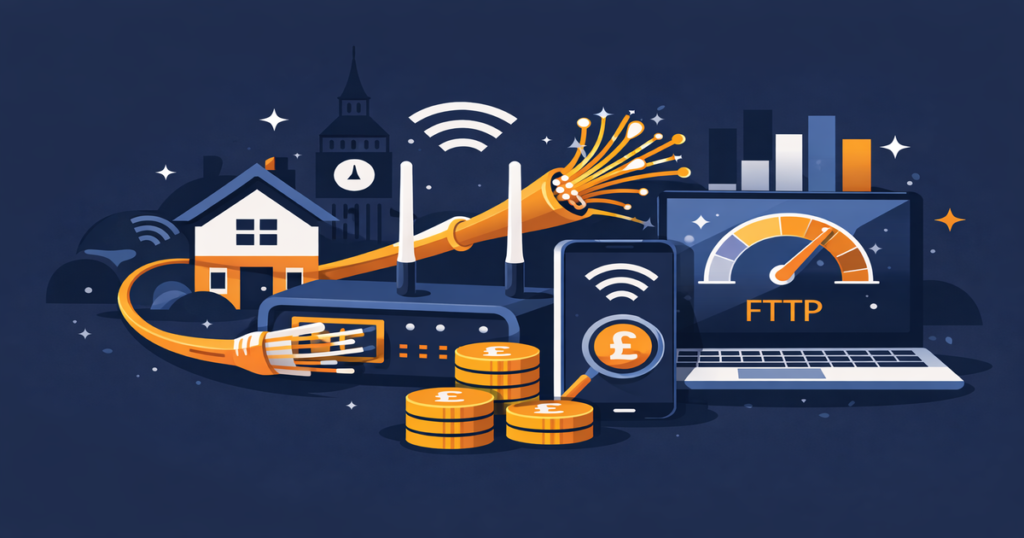
full fibre broadband UK 2026 — What Is Full Fibre Broadband and Why Does It Matter in 2026
Full fibre broadband has gone from a niche upgrade to a mainstream option for millions of UK households. As of April 2026, more than 80 per cent of UK premises can now order a full fibre connection, and with prices falling sharply over the past two years, the question is no longer whether full fibre is available but whether it makes financial sense for your household to switch.
The answer depends on what you are currently paying, how many people and devices share your connection, and whether your existing broadband is actually delivering the speeds you need. This guide walks through every element of that decision — from the technical differences between fibre types to worked cost examples, the latest Ofcom regulatory changes, and a step-by-step switching checklist — so you can make a confident, well-informed choice about full fibre broadband UK 2026.
FTTP vs FTTC: The Key Difference
The distinction that matters most is between fibre to the premises (FTTP) and fibre to the cabinet (FTTC). These two terms describe fundamentally different types of connection, and the gap between them is far more significant than most marketing material suggests.
- FTTC (fibre to the cabinet) — fibre optic cable runs from the exchange to a green street cabinet near your home, but the final stretch from the cabinet to your property uses the existing copper telephone line. This limits speeds to around 40 to 80 Mbps for downloads and 10 to 20 Mbps for uploads. The further your home is from the cabinet, the slower your connection is likely to be.
- FTTP (fibre to the premises) — fibre optic cable runs all the way from the exchange directly into your home.
There is no copper involved at any point. This allows speeds of 150 Mbps to 1.8 Gbps for downloads and up to 115 Mbps or more for uploads, depending on the package you choose.
When broadband providers advertise “fibre broadband,” they may be referring to either type. The label alone does not tell you whether you are getting a true full fibre connection or a copper-dependent FTTC service. Always check whether a deal is FTTP before assuming you are getting full fibre speeds and reliability.
How Full Fibre Changes Your Internet Experience
The practical differences between FTTC and FTTP go well beyond headline download speeds. Full fibre connections are more stable, suffer fewer outages, and deliver consistent performance regardless of the time of day or how many neighbours are online. Copper-based connections are more susceptible to electrical interference, water ingress, and signal degradation over distance — problems that simply do not apply to fibre optic cable.
For households that depend on a reliable connection for remote work, video conferencing, online learning, or streaming across multiple devices, full fibre removes most of the common frustrations associated with broadband. Buffering during peak hours, stuttering video calls, and slow file uploads become far less likely on a properly provisioned FTTP connection.
Upload speeds deserve particular attention. On a typical FTTC connection, upload speeds max out at around 10 to 20 Mbps.
On full fibre, even entry-level packages typically offer 20 to 30 Mbps uploads, with higher-tier plans delivering 50 to 115 Mbps. If anyone in your household regularly uploads large files, backs up data to the cloud, live-streams, or makes video calls, the improvement in upload performance alone can justify the switch.
The Ofcom 2026-2031 Framework and What It Means for You
In early 2026, Ofcom published its Telecoms Access Review 2026-31, the updated regulatory framework for the UK broadband market covering the period from 2026 to 2031. The key objective is to encourage continued investment in full fibre networks while ensuring that consumers benefit from competitive pricing and transparent deal terms.
For households considering full fibre, the practical effect is that pricing is expected to remain competitive. Ofcom has set rules around wholesale access to Openreach’s network that are designed to prevent prices from rising unchecked, while also giving network builders enough commercial incentive to keep expanding coverage. The regulator has also strengthened requirements around mid-contract price transparency and switching processes, making it easier than ever for consumers to compare deals and move between providers.
You can read more about Ofcom’s broadband regulation on their official phones and broadband pages.
UK Full Fibre Availability: Where Can You Get It
Full fibre availability has expanded rapidly across the UK, driven by billions of pounds of investment from Openreach, alternative network operators, and government-backed programmes like Project Gigabit. However, coverage is not uniform, and where you live still has a significant impact on which providers and packages are available to you.
National Coverage in April 2026
As of April 2026, full fibre to the premises is available to approximately 83 per cent of UK homes, up from around 52 per cent at the start of 2025 and just 27 per cent in early 2023. The pace of rollout has exceeded earlier forecasts, though it has slowed in some areas as network builders move from dense urban locations to harder-to-reach suburban and semi-rural properties.
The government’s target of reaching 85 per cent gigabit-capable coverage by the end of 2025 — including cable networks that have been upgraded to offer gigabit speeds — has broadly been met when cable and FTTP are combined. Pure FTTP coverage has now reached approximately 83 per cent, with industry projections suggesting 90 per cent or more FTTP availability by 2028.
Openreach, CityFibre, and Alternative Networks
The UK’s full fibre landscape is not a single network but a patchwork of competing infrastructure providers, each building in different areas and at different speeds.
- Openreach — the largest network, aiming to reach 25 million premises with full fibre by the end of 2026. Openreach’s network underpins broadband services from BT, Sky, TalkTalk, Plusnet, Vodafone, and many smaller providers. If your area is covered by Openreach FTTP, you will have the widest choice of retail providers.
- CityFibre — the UK’s third-largest fixed network, building full fibre in towns and cities across the country. CityFibre’s network is used by providers including Vodafone, TalkTalk, and Zen Internet.
Coverage tends to be concentrated in urban areas.
- Virgin Media O2 (VMO2) — while not strictly full fibre in all areas, VMO2’s upgraded cable network delivers gigabit-capable speeds across much of its footprint. The company is also deploying FTTP in some locations.
- Alternative networks (altnets) — dozens of smaller operators such as Hyperoptic, Community Fibre, Gigaclear, Trooli, Zzoomm, and others have built or are building full fibre networks in specific towns, cities, or rural areas. These providers often offer competitive pricing and may be the only full fibre option in some locations.
How to Check If Full Fibre Is Available at Your Address
The quickest way to check whether full fibre has reached your home is to use the Openreach fibre checker, which will tell you whether FTTP is available, planned, or not yet scheduled for your postcode. For alternative networks, you will usually need to check each provider’s website individually, as their coverage does not always appear on Openreach’s tool.
It is worth checking multiple sources. Your address may be served by CityFibre or a local altnet even if Openreach has not yet reached your street. Broadband comparison sites can help by showing all available deals at your postcode, but they do not always include every provider, so a direct check with any local operators is advisable.
Rural vs Urban Availability
The most significant divide in full fibre availability remains the gap between urban and rural areas. In major cities and large towns, FTTP coverage typically exceeds 70 to 80 per cent, with multiple competing networks in many locations. In rural and semi-rural areas, coverage is far more patchy, with some villages and hamlets still relying on ADSL connections delivering under 10 Mbps.
The government’s Project Gigabit programme is directing public funding towards areas where commercial rollout is not viable, but progress has been slower than hoped. If you live in a rural area without full fibre, it is worth checking whether a community broadband scheme or local altnet is operating nearby, as these sometimes offer connections that do not appear on mainstream comparison tools.
For a broader look at the deals currently available across different speed tiers and locations, our complete provider comparison guide covers the full range of options.
How Much Does Full Fibre Cost Compared to Standard Broadband
One of the biggest changes in the UK broadband market over the past two years has been the falling cost of full fibre relative to older FTTC packages. In many cases, the monthly price difference between a 36 Mbps FTTC deal and a 150 Mbps FTTP deal is now less than £5 a month, and during promotional periods, full fibre can actually be cheaper than superfast copper-based broadband from the same provider.
Entry-Level Full Fibre Under £25 Per Month
Several providers now offer full fibre packages with speeds of 150 Mbps or above for under £25 a month on 18 or 24-month contracts. These entry-level FTTP deals represent excellent value for most households and are typically sufficient for families of three or four with moderate to heavy internet usage.
At these speeds, you can comfortably stream in 4K on two devices simultaneously, make video calls without interruption, and handle online gaming with low latency. Unless your household has exceptionally high bandwidth demands, an entry-level full fibre package will cover your needs at a price comparable to — or in some cases lower than — a standard FTTC deal.
If keeping your monthly bill as low as possible is the priority, our guide to the cheapest broadband in the UK for 2026 includes the most affordable full fibre options alongside budget FTTC deals.
Mid-Range Full Fibre Between £25 and £35 Per Month
The mid-range tier covers speeds of roughly 150 to 500 Mbps and is where most providers concentrate their marketing efforts. Monthly prices in this bracket typically fall between £25 and £35, with the exact figure depending on the provider, contract length, and whether any promotional discount applies.
For larger households with five or more connected devices, or for anyone who regularly downloads large files, this tier offers a comfortable margin of headroom. Upload speeds at this level are also meaningfully better than FTTC, typically sitting between 30 and 50 Mbps, which makes a real difference for cloud backups, video calls, and content creation.
Gigabit Full Fibre Above £35 Per Month
Gigabit packages delivering speeds of 900 Mbps to 1.8 Gbps are now available from most major providers at prices ranging from £35 to £55 a month. These are the fastest residential connections available in the UK and represent significant overkill for the vast majority of households.
That said, gigabit pricing has fallen substantially. Two years ago, a 1 Gbps connection would typically cost £50 or more per month.
Today, aggressive competition between providers has pushed some gigabit deals below £40 a month, making them only marginally more expensive than mid-range packages. If you are signing a 24-month contract and want maximum future-proofing, the premium for gigabit speeds is now small enough to be worth considering.
Worked Example: Total Two-Year Cost Including Mid-Contract Price Rises
Headline monthly prices can be misleading when mid-contract price rises are factored in. Since January 2025, Ofcom has banned inflation-linked and percentage-based mid-contract rises for new contracts — providers must now state any annual increase as a fixed pounds-and-pence amount upfront.
For April 2026, typical rises on new contracts are: BT, EE and Plusnet +£4 a month; Virgin Media +£4 a month; Sky +£3 a month; and Vodafone +£3.50 a month. Customers who signed contracts before January 2025 may still be on the older CPI + 3.9 per cent terms.
Here is a worked example showing the true two-year cost of a typical mid-range full fibre deal signed in 2026.
- Advertised monthly price: £28 a month for 300 Mbps full fibre on a 24-month contract
- Year 1 cost: £28 x 12 = £336
- Mid-contract rise (fixed £4 a month increase): £28 + £4 = £32 a month
- Year 2 cost: £32 x 12 = £384
- Total two-year cost: £336 + £384 = £720
- Effective monthly cost over 24 months: £720 / 24 = £30 a month
Compare this with an FTTC deal advertised at £27 a month for 36 Mbps:
- Year 1 cost: £27 x 12 = £324
- After fixed £4 a month rise: £27 + £4 = £31 a month
- Year 2 cost: £31 x 12 = £372
- Total two-year cost: £324 + £372 = £696
- Effective monthly cost over 24 months: £696 / 24 = £29 a month
The difference between the two is £24 over two years, or just £1 a month extra for a connection that is more than eight times faster. For most households, that premium is a no-brainer. For a deeper look at how mid-contract rises affect different deals, see Ofcom’s guide to mid-contract price rises.
Do You Actually Need Full Fibre Speeds
Speed is one of those areas where broadband marketing consistently encourages people to buy more than they need. Before committing to a full fibre package, it is worth honestly assessing whether your household will benefit from the upgrade or whether a cheaper FTTC deal would serve you just as well.
Matching Speed to Household Usage
The right speed for your home depends on three factors: what you do online, how many people are doing it at the same time, and how many devices are connected. Here is a rough guide:
- 1-2 people, light usage (browsing, email, social media, one HD stream): 30 to 50 Mbps is more than sufficient. An FTTC deal will serve you well.
- 2-3 people, moderate usage (multiple HD streams, video calls, some gaming): 80 to 150 Mbps is the sweet spot.
Entry-level full fibre is ideal.
- 4+ people, heavy usage (multiple 4K streams, competitive online gaming, large file uploads, smart home devices): 150 to 500 Mbps provides comfortable headroom. Mid-range full fibre is the sensible choice.
- Power users (content creators, home servers, regular large downloads): 500 Mbps to 1 Gbps. Gigabit full fibre may genuinely be worthwhile.
How Many Devices Can Your Current Connection Handle
The average UK household now has somewhere between 10 and 15 connected devices, including phones, tablets, laptops, smart TVs, games consoles, smart speakers, doorbells, thermostats, and other IoT gadgets. Not all of these are active at the same time, but during peak evening hours it is not uncommon for six or seven devices to be drawing on your bandwidth simultaneously.
A 36 Mbps FTTC connection can handle this if usage is relatively light across those devices, but it will struggle if two people are streaming in 4K while a third is on a video call and a fourth is downloading a game update. A 150 Mbps full fibre connection handles the same scenario with ease, with bandwidth to spare.
Upload Speeds: The Hidden Advantage of Full Fibre
Upload speed is the most underappreciated advantage of full fibre broadband. On FTTC connections, upload speeds are typically capped at 10 to 20 Mbps regardless of the download speed you are paying for. On full fibre, upload speeds start at around 20 Mbps on entry-level packages and can reach 115 Mbps or more on higher-tier plans.
This matters more than many people realise. Every video call you make, every photo you upload to social media, every file you send via email or cloud storage, every cloud backup that runs in the background — all of these depend on upload speed. If you have ever experienced a video call where your image freezes while the other person looks fine, the most likely cause is insufficient upload bandwidth.
For anyone who works from home regularly, the upload speed improvement alone can make full fibre worth the upgrade. A 50 Mbps upload transforms the experience of sharing large files, presenting in online meetings, and using cloud-based applications compared with the 10 Mbps upload that most FTTC connections deliver.
Future-Proofing Your Home
Broadband demand has roughly doubled every three to four years for the past two decades, and there is no sign of that trend slowing. Streaming resolutions continue to increase, cloud computing is replacing local storage, smart home devices are proliferating, and emerging technologies such as augmented reality applications and cloud gaming will place even greater demands on home connections.
If you are signing an 18 or 24-month contract, it makes sense to consider where your usage will be at the end of that term, not just where it is today. Choosing full fibre now means you are unlikely to find your connection inadequate before your contract expires, whereas an FTTC deal that feels comfortable today may feel constrained within a year or two.
The Ofcom 2026-2031 Fibre Rules Explained
Ofcom’s regulatory decisions have a direct impact on what you pay for broadband and how easy it is to switch between providers. The Telecoms Access Review 2026-31 introduces several changes that are relevant to anyone considering a full fibre upgrade.
What Ofcom Has Changed
The core of Ofcom’s updated approach involves setting the terms under which competing broadband providers can access Openreach’s network infrastructure. Openreach is required to offer wholesale access to its full fibre network at regulated prices, which in turn determines the floor for what retail providers like BT, Sky, and TalkTalk charge consumers.
Key changes in the 2026-2031 framework include:
- Continued wholesale price regulation — Ofcom has maintained regulated access pricing for Openreach’s fibre network, preventing wholesale charges from rising sharply and feeding through into higher retail prices.
- Stronger switching protections — the One Touch Switch process, which allows customers to switch providers with a single contact, has been reinforced with clearer rules around timelines and compensation for failed switches.
- Enhanced transparency on pricing — providers must now present total contract costs including projected mid-contract rises more prominently during the sales process, making it harder for misleading headline prices to distort consumer decisions.
- Protections for vulnerable customers — Ofcom has expanded requirements for providers to offer social tariffs and to identify customers who may be struggling to pay their bills, with a view to reducing digital exclusion.
How the New Rules Affect Pricing and Competition
By keeping wholesale access prices in check, Ofcom’s framework helps to maintain competitive pressure in the retail market. Providers that use Openreach’s network cannot be priced out by excessive wholesale charges, and the continued availability of regulated access means that new entrants can compete without needing to build their own infrastructure.
For consumers, the practical effect is that full fibre prices are expected to remain stable or continue their gradual decline over the next few years. The market is not a monopoly — multiple infrastructure providers are competing in many areas — and Ofcom’s regulation is designed to prevent any single player from exploiting a dominant position to raise prices above competitive levels.
What This Means for Consumers
If you are shopping for full fibre broadband UK 2026, the regulatory environment is broadly in your favour. Competition is strong, switching is straightforward, and transparency requirements mean you can compare deals on a like-for-like basis more easily than at any point in the past. The main risk is inaction — staying on an out-of-contract deal and paying well over the odds for a service that is readily available at a lower price from a competitor.
Best Full Fibre Broadband UK 2026 Deals Available Right Now
The full fibre market moves quickly, with providers regularly adjusting prices and promotional offers. The deals below reflect the general pricing landscape as of April 2026. For the most current offers at your specific postcode, we recommend checking our regularly updated best broadband deals comparison.
Best for Budget
If your priority is keeping monthly costs as low as possible while still getting a genuine full fibre connection, look for entry-level FTTP packages in the 150 Mbps range priced between £18 and £24 a month. Several providers, including some smaller altnets and budget-focused brands using the Openreach network, offer deals at or below £22 a month on 24-month contracts.
At this price point, you are typically getting speeds that are two to four times faster than a standard FTTC connection, along with meaningfully better upload speeds and reliability. The trade-off may be a less well-known brand or limited bundling options, but for broadband-only service, these deals are hard to beat on value.
Best for Speed
Gigabit full fibre — delivering download speeds of 900 Mbps to 1.8 Gbps — is now available from multiple providers at prices ranging from £36 to £50 a month. The fastest deals tend to come from dedicated fibre operators such as Hyperoptic and Community Fibre in the areas they cover, or from providers using the CityFibre network.
If outright speed is your priority and you want the fastest connection available at your address, these gigabit plans deliver. Upload speeds on gigabit packages typically range from 50 to 115 Mbps, which is particularly valuable for remote workers, content creators, and households with heavy cloud usage.
Best for No Mid-Contract Price Rises
Since Ofcom banned percentage-based and inflation-linked mid-contract rises for new contracts from January 2025, all providers must now state any annual increase as a fixed pounds-and-pence amount. This is a significant improvement in transparency, but the rises can still add up — a £4 a month increase on a two-year deal adds £48 to your total cost.
Some providers go further and offer fully fixed-price contracts where the monthly cost stays exactly the same for the full contract term. These deals typically start slightly higher than equivalent contracts with a stated rise — perhaps £2 to £4 a month more — but the total two-year cost can actually be lower once you account for the annual increase you avoid.
If predictability matters to you, these contracts are worth prioritising. Our cheap broadband deals guide for April 2026 flags which providers currently offer fixed-price terms.
Best for Short Contracts
Most full fibre deals come on 18 or 24-month contracts, but a handful of providers offer 12-month or even 30-day rolling options. These shorter commitments typically cost more per month — often £5 to £10 extra compared with the same speed on a longer contract — but they offer flexibility if you are renting, expecting to move, or simply prefer not to be tied down.
Rolling monthly contracts are particularly useful if you want to try full fibre before committing to a longer term, or if you are in rented accommodation where you may need to leave at relatively short notice. The higher monthly cost is the price of that flexibility, and for many households it is a reasonable trade-off.
How to Switch to Full Fibre Broadband
Switching broadband provider has become considerably easier in recent years, thanks largely to the One Touch Switch process introduced by Ofcom. If you are on a standard FTTC or ADSL connection and want to move to full fibre, the process is straightforward in most cases, though there are a few things to be aware of.
The One Touch Switch Process
Under One Touch Switch, you simply sign up with your new provider and they handle the rest. You do not need to contact your existing provider to cancel — the new provider manages the switchover on your behalf. The process typically takes 10 to 14 working days from the point you place your order, though it can be faster in some cases.
When you sign up, your new provider will confirm the switch date, notify your old provider, and arrange any installation that is needed. On the switch date, your old service is disconnected and your new service goes live, usually within the same day. In most cases, there is little or no gap in service.
What Happens During Installation
If you are moving from FTTC or ADSL to full fibre for the first time, an engineer visit is usually required to install the fibre optic cable to your property. This is a one-off process that typically takes two to four hours, depending on the complexity of the installation and whether the fibre network has already been laid in your street.
The engineer will run a fibre cable from the nearest distribution point to your property and install a small optical network terminal (ONT) — a white box roughly the size of a paperback book — on an inside wall, usually near your existing telephone socket or wherever the fibre enters the building. Your new router connects to this ONT, and from that point your broadband runs entirely over fibre.
In many cases, the installation is free. Some providers charge a one-off installation fee of £10 to £60, particularly for more complex installations involving external cable routing or work in blocks of flats.
The fee, if any, will be confirmed before you commit to the order.
Avoiding Early Termination Fees
If you are still within a fixed-term contract with your current provider, leaving early will usually trigger an early termination fee (ETF). This is typically calculated as the remaining monthly payments on your contract, sometimes with a discount applied. On a £30 a month deal with six months remaining, you might face an ETF of £90 to £180 depending on the provider’s terms.
The best way to avoid ETFs is to time your switch for when your current contract ends. Most providers notify you 30 to 46 days before your contract expires, and this is the ideal window to shop around and arrange your move to full fibre. If your contract has already expired and you are on a rolling monthly deal, you can switch at any time without penalty.
In some cases, the savings from switching to a cheaper full fibre deal may outweigh the ETF. If you are paying £45 a month out of contract and can switch to a full fibre deal at £25 a month, the £20 monthly saving will quickly recoup a modest termination charge. It is worth doing the arithmetic before assuming you need to wait.
Equipment You May Need
Your new full fibre provider will supply a router as part of your package. In most cases, this is included at no extra cost, though some providers offer a basic router for free with the option to upgrade to a more advanced model — often a mesh Wi-Fi system — for an additional monthly fee or one-off charge of £50 to £150.
For most households, the standard router supplied by the provider is perfectly adequate. If you have a large home or struggle with Wi-Fi coverage in certain rooms, a mesh system with two or three units can extend coverage more effectively than a single router, but this is an optional extra rather than a necessity. You can also use your own router with most providers, though you may need to configure it to work with the ONT.
Common Concerns About Switching to Full Fibre
Despite the clear advantages of full fibre broadband, many households hesitate to switch because of practical concerns about the process. Most of these worries are either outdated or less significant than people assume.
Will I Lose My Landline
This is one of the most common questions, and the answer requires some nuance.
Full fibre broadband replaces the copper telephone line with a fibre connection. If you currently have a traditional analogue landline that works through the copper network, this will eventually need to change as the UK’s copper network is being switched off, with a target completion date of 2027.
However, you will not lose the ability to make and receive calls. Voice services on full fibre are delivered over the internet using Voice over IP (VoIP) technology.
Your phone number can be kept, and in most cases you can continue using your existing handset with an adapter or a VoIP-enabled phone. The call quality is typically equal to or better than a traditional landline.
If you rely on your landline for a telecare alarm, personal alarm pendant, or other critical device, it is essential to check with your alarm provider that their equipment is compatible with a VoIP connection before switching. Most modern alarm systems work over broadband without issues, but older analogue units may need updating.
Is the Installation Disruptive
The installation process requires an engineer to visit your property, and there will be some minor disruption. The engineer may need to drill a small hole through an external wall to bring the fibre cable inside, and there will be a new box (the ONT) mounted on an internal wall. The installation typically takes two to four hours, and someone over 18 needs to be present throughout.
In practice, most installations are straightforward and cause minimal disruption. The engineer will discuss the best route for the cable and the most convenient location for the ONT before starting work. If you have preferences about where equipment is placed, make these clear at the beginning of the appointment.
What If My Building Is Not Ready
If you live in a flat or a building with shared access, the situation can be more complex. Fibre needs to be brought into the building and distributed to individual properties, which may require permission from the building owner, management company, or freeholder.
In some cases, the necessary internal wiring has already been installed. In others, it has not.
If your building is not yet equipped for full fibre, some providers offer to arrange the internal cabling work at no cost to residents, but this requires agreement from the building owner. The process can take weeks or months to arrange, so it is worth starting the conversation early if you know you want full fibre and your building does not yet have it.
Can I Go Back If I Change My Mind
Under Ofcom rules, you have a 14-day cooling-off period from the date your new service is activated (or from the date you receive your new equipment, whichever is later). During this period, you can cancel your new contract without penalty and return to your previous provider.
After the cooling-off period, you are bound by the terms of your contract.
However, the One Touch Switch process means that if you decide to switch again — either back to your old provider or to a different one — the process is the same simple procedure. You just sign up with the new provider and they handle the switch.
Your Full Fibre Decision Checklist
Making the right choice about full fibre broadband comes down to a systematic assessment of your situation. Work through these four steps to arrive at a well-informed decision.
Step 1: Check Availability
Before anything else, confirm whether full fibre is available at your address.
Use the Openreach fibre checker and check directly with any alternative network operators that may serve your area. If FTTP is not yet available, note the expected rollout timeline — if it is due within six months, you may want to take a short-term deal on your current connection rather than committing to a long contract on FTTC.
Step 2: Assess Your Needs
Consider your household’s actual broadband usage. How many people live in your home? How many devices are connected? Does anyone work from home regularly? Do you stream in 4K? Do you game online? Are video calls a daily occurrence? Be honest about whether your current connection genuinely struggles or whether the desire for full fibre is driven more by the appeal of faster speeds than by a real performance problem.
For most households of two to four people with moderate internet usage, a 100 to 150 Mbps full fibre connection will be more than adequate. Paying more for gigabit speeds is only worthwhile if your household genuinely uses the bandwidth.
Step 3: Compare Deals
Once you know what speed you need, compare the total cost of deals over the full contract term, not just the headline monthly price.
Account for mid-contract price rises, any setup or installation fees, and whether the router is included or costs extra. Our broadband comparison guide can help you evaluate the full picture.
Pay particular attention to:
- Total two-year cost — the sum of all monthly payments including projected price rises, plus any one-off fees.
- Contract length — 24-month deals are usually cheapest per month, but 18-month contracts offer more flexibility.
- Price rise policy — fixed-price contracts offer certainty; contracts with a stated annual rise (now required to be a fixed pounds-and-pence amount) will cost more in year two.
- Exit terms — understand the early termination fee structure in case your circumstances change.
Step 4: Time Your Switch
The ideal time to switch is when your current contract expires. This avoids any early termination fees and puts you in the strongest negotiating position. If your contract has already ended and you are on a rolling monthly rate, you are likely overpaying significantly and should switch as soon as you have identified the right deal.
Keep an eye on seasonal promotions. Broadband providers tend to offer their most competitive deals during key sales periods — January, Black Friday, and back-to-school in September are common times for aggressive pricing. However, the difference between a promotional deal and a standard price is often modest, so do not wait months for a sale if your current contract is costing you far more than necessary in the meantime.
Frequently Asked Questions
What is full fibre broadband and how is it different from standard fibre
Full fibre broadband, also known as FTTP (fibre to the premises), uses fibre optic cable all the way from the exchange to your home. Standard fibre, or FTTC (fibre to the cabinet), uses fibre only to a street cabinet and then relies on copper wire for the final connection. Full fibre delivers significantly faster speeds, better upload performance, and greater reliability because there is no copper involved.
How fast is full fibre broadband in the UK
Full fibre broadband UK 2026 speeds range from around 150 Mbps on entry-level packages to 1.8 Gbps on the fastest plans. The most popular residential packages offer speeds between 150 and 500 Mbps. Upload speeds are also much faster than FTTC, typically ranging from 20 to 115 Mbps depending on the package.
Is full fibre broadband available at my address
Approximately 83 per cent of UK premises can access full fibre as of April 2026. The quickest way to check is by using the Openreach fibre checker at your postcode, and also checking directly with alternative network operators such as CityFibre, Hyperoptic, or any local providers that serve your area.
How much does full fibre broadband cost per month
Entry-level full fibre packages start from around £18 to £24 a month for speeds of around 150 Mbps. Mid-range packages offering 150 to 500 Mbps typically cost £25 to £35 a month.
Gigabit plans range from £36 to £55 a month. Prices vary by provider, contract length, and any promotional offers available.
Do I need an engineer visit to get full fibre installed
Yes, if you are getting full fibre for the first time, an engineer will need to visit your property to install the fibre cable and an optical network terminal (ONT). The visit typically takes two to four hours, and someone over 18 must be present. Installation is often free, though some providers charge a one-off fee of £10 to £60.
Will I lose my landline number if I switch to full fibre
No. You can keep your existing phone number when switching to full fibre.
Voice calls are delivered over the internet using VoIP technology rather than through the copper telephone network. The call quality is typically as good as or better than a traditional landline, and your number transfers across.
What happens to my broadband during the switch to full fibre
Under the One Touch Switch process, your new provider coordinates the changeover with your old provider. In most cases, your old service is disconnected and your new full fibre service is activated on the same day, so any gap in service is minimal. If there is an unexpected delay, you should contact your new provider, who is responsible for managing the transition.
Can I avoid mid-contract price rises on full fibre deals
Yes. Since January 2025, Ofcom requires all new contracts to state any mid-contract rise as a fixed pounds-and-pence amount rather than the old CPI-linked percentage formula.
This makes costs more predictable, but some providers go further and offer fully fixed-price contracts where your monthly cost stays the same for the entire contract term. These deals typically cost £2 to £4 more per month upfront, but the total cost over two years can be lower because you avoid the annual increase entirely. Check each provider’s pricing policy before signing up.
Is gigabit full fibre worth paying extra for
For most households, gigabit speeds are more than is needed. A 150 to 300 Mbps connection comfortably handles multiple 4K streams, video calls, gaming, and heavy downloads simultaneously. Gigabit is worth considering if you have a very large household with many heavy users, if you regularly transfer very large files, or if the price premium over a mid-range package is small enough that the future-proofing value justifies the extra cost.